
Last Updated: December 2025
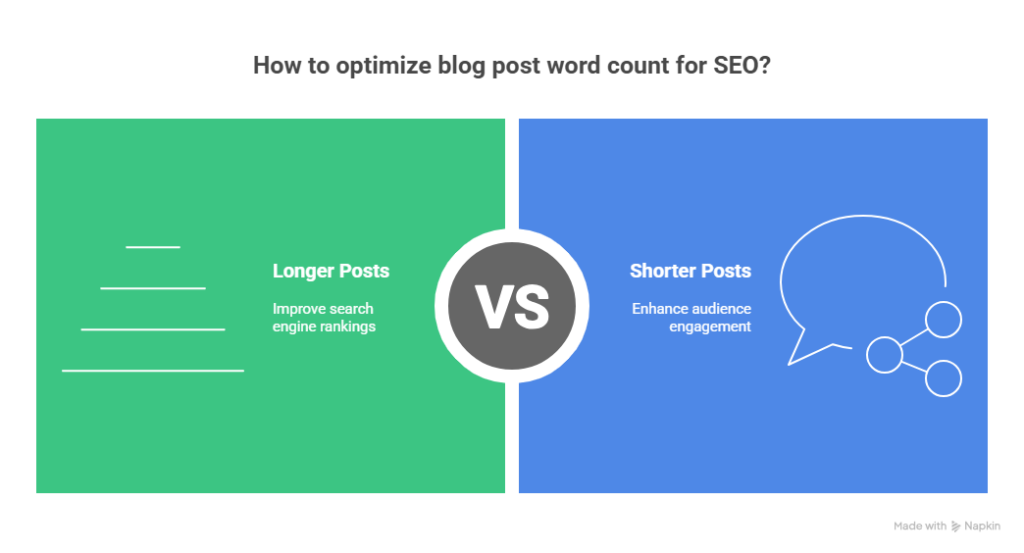
How many words should a blog post be for SEO in 2026? There’s no single magic number. The ideal blog post length depends on search intent, topic complexity, and SERP analysis of competitor word counts. Most successful blog posts range from 1,000 to 2,500 words, but Google’s Helpful Content Update prioritizes content depth and user engagement metrics over arbitrary word count targets. Focus on comprehensive content that fully answers queries while maintaining optimal blog length for your specific niche.
The Truth About Blog Post Word Count SEO in 2026
2026 Strategy: SEO expert Nathan Gotch breaks down why “Topic Depth” beats “Word Count” in the new algorithm.[web:3]
You’ve seen conflicting advice about how many words should a blog post be for SEO. Some experts recommend 3,000+ word articles. Others claim shorter posts perform better. Reddit threads debate whether 600 words is enough or if long form content SEO always wins.
Here’s what actually drives rankings in 2026.
Google’s algorithms prioritize helpful content that satisfies search intent. The search engine doesn’t use word count as a direct ranking factor. What matters is whether your content depth meets user needs and demonstrates topical authority.
When you analyze the top 10 SERP results for competitive keywords, longer content often ranks better. But this happens because comprehensive topics naturally require more words to cover thoroughly, not because hitting a specific word count target improves rankings.
Does Word Count Still Matter for SEO in 2026?
Word count matters indirectly through content quality signals.
Think about how many words should a blog post be for SEO from Google’s perspective. If someone searches for a complex topic, they expect detailed answers. A 400-word post can’t provide the content depth needed for topics like “comprehensive SEO strategy” or “complete guide to content marketing.”
Google’s Helpful Content Update specifically targets thin content created primarily for search engines rather than humans. The algorithm detects when you pad articles to hit word count targets without adding real value.
Modern SEO content length strategy balances thoroughness with user experience. Write enough to fully answer queries. Stop when you’ve said everything useful. Check if your length aligns with top ranking content through basic SERP analysis.
Search Intent Determines Optimal Blog Length
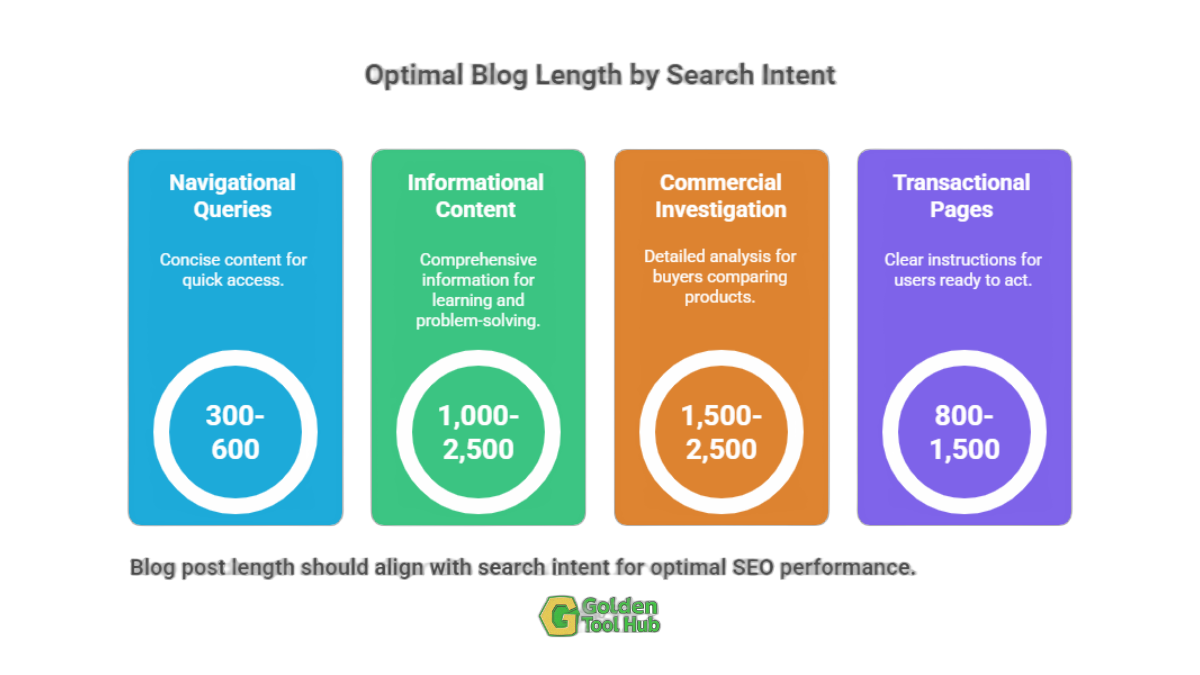
Search intent tells you exactly how many words should a blog post be for SEO in your niche. Forget generic word count advice. Analyze what users actually want.
Navigational Queries (300-600 words)
Users searching for specific brands or pages want quick access. These navigational queries need concise content.
Examples: “Golden Tool Hub word counter,” “Yoast SEO plugin,” “Grammarly login”
Target: 300-600 words with clear navigation and direct answers. Going longer adds no value.
Informational Content (1,000-2,500 words)
People researching topics need comprehensive information. They’re learning, comparing options, or solving problems.
Examples: “how to improve blog readability,” “what is keyword density analysis,” “SEO trends 2026”
Optimal blog length: 1,000-2,500 words with sections, examples, and actionable steps. This is where content depth SEO becomes critical.
Commercial Investigation (1,500-2,500 words)
Buyers comparing products before purchase need detailed analysis, feature breakdowns, and use cases.
Examples: “best word counter tools 2026,” “content writing software comparison,” “SEO tools review”
Target: 1,500-2,500 words with comparison tables and expertise demonstration through detailed reviews.
Transactional Pages (800-1,500 words)
Users ready to take action want clear instructions, pricing, trust signals, and next steps.
Examples: “buy domain name,” “download free word counter,” “sign up for SEO tools”
Ideal blog post length: 800-1,500 words with strong calls to action and experience signals.
SERP Word Count Analysis Framework
Stop guessing how many words should a blog post be for SEO. Use data from actual top 10 SERP results.
Step 1: Identify Your Target Keyword
Start with your primary keyword. Be specific. “Blog writing tips” is too broad. “How to write SEO blog posts for small business” works better for long-tail keywords.
Step 2: Analyze Top 10 Competitors
Search your keyword. Open the top 10 organic results (skip ads and AI overviews). Check their word counts using our free word counter tool to get an accurate baseline.
Calculate the average. If top results average 2,200 words, that’s your baseline for optimal article length in this niche.
Step 3: Identify Content Gaps
Read those top 10 competitors thoroughly. Make lists of questions they answer and questions they miss.
Your content should cover everything competitors cover, plus fill the gaps they missed. This naturally determines how many words should a blog post be for SEO in your specific case.
Step 4: Check Content Depth
Count how many subtopics each top result covers. Note their heading structures, data points, examples, and visual elements.
Comprehensive content length isn’t just about words. It’s about thoroughness. A well-structured 1,500-word post with clear expertise demonstration often outranks a rambling 3,000-word article.
Step 5: Monitor User Engagement Metrics
After publishing, track bounce rate, time on page, and scroll depth. Low engagement means your blog post word count might be wrong for your audience.
If people leave quickly, you’re either too long (boring) or too short (incomplete). Adjust based on real user behavior, not assumptions about ideal blog post length.
The 80/20 Rule for Blog Post Length SEO
The Pareto Principle applies perfectly to determining how many words should a blog post be for SEO.
Focus 80% of your effort on the 20% of content that drives results. Here’s how this works for SEO content length strategy.
Not every piece of content needs to be long-form. When repurposing this content for LinkedIn or X (Twitter), you face much stricter constraints. Check our guide on Social Media Character Limits 2026 to optimize your snippets for every platform.
Core Content First (Your 20%)
Identify the main question your post answers. Write a complete, direct answer first. This usually takes 600-1,000 words and delivers 80% of user value.
Answer the query fully in this core section. Include key data, clear explanations, and actionable insights. Don’t save your best information for later.
Supporting Content Next (Your 80%)
Add related questions, deeper examples, data visualization, expert insights, and step-by-step guidance. This fills out the remaining 1,000-1,500 words.
Supporting content demonstrates topical authority and helps with featured snippet optimization for related long-tail keywords.
The 80/20 rule also means 20% of your blog posts drive 80% of traffic. Those high-performing posts deserve longer optimal blog length, better research, regular updates, and stronger E-E-A-T signals.
Your quick tips and news updates can stay short at 600-800 words. Save the 3,000+ word comprehensive guides for topics that truly need that depth.
Knowing the ideal length is only half the battle; you also need a reliable way to track your progress without distractions. Check out our guide to the best free word counter tools to find the perfect companion for your SEO writing.
Optimal Blog Length by Industry and Niche
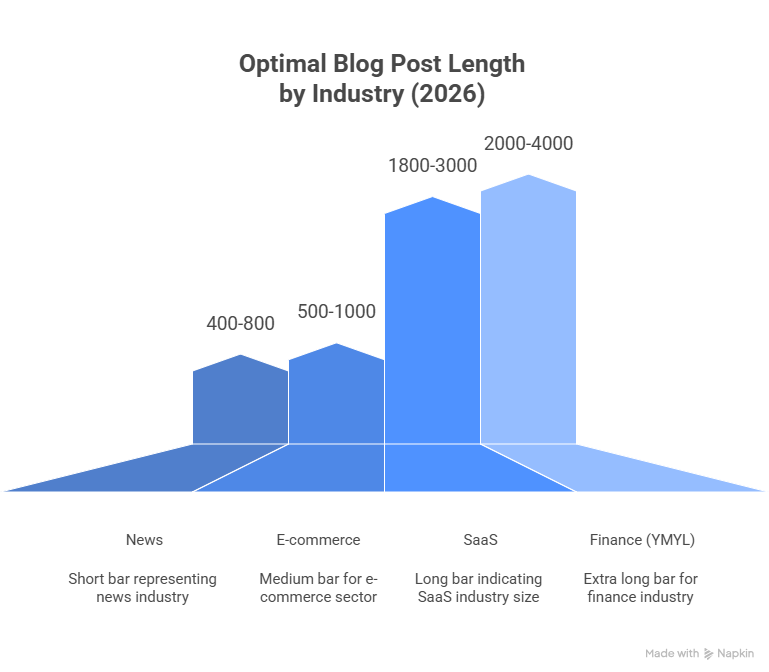
How many words should a blog post be for SEO varies dramatically by niche. Here’s what SERP analysis reveals for different industries in 2026.
SaaS and B2B Technology (1,800-3,000 words)
Decision makers need proof before buying expensive software. They want feature comparisons, integration details, use cases, ROI calculations, and security information.
Shorter content doesn’t build enough trust for complex B2B purchases. The ideal blog post length here includes comprehensive coverage with strong expertise demonstration.
Example topics: “project management software comparison 2026,” “API documentation best practices,” “enterprise security solutions review”
E-commerce Product Pages (500-1,000 words)
Product descriptions need enough detail to answer questions and reduce returns, but not so much that shoppers get overwhelmed.
Focus your SEO blog word count on specifications, benefits, use cases, and trust signals like reviews. Skip company history unless it’s directly relevant to product quality.
Local Service Businesses (800-1,500 words)
Local service pages need to establish expertise while covering service details without drowning readers in unnecessary information.
Optimal article length includes service descriptions, pricing guidance, service area details, author credentials (owner/operator experience), and source citations from satisfied customers.
Health and Finance YMYL Content (2,000-4,000 words)
Your Money Your Life topics require extensive E-E-A-T signals to satisfy Google’s quality standards. YMYL guidelines demand thorough coverage with expert verification.
These niches need clear author credentials, medical or financial expert reviews, source citations to authoritative research, and extremely comprehensive content depth. Never guess about blog post word count SEO for YMYL topics. Always exceed competitor averages.
News and Trending Topics (400-800 words)
Breaking news needs speed over depth. Quick reporting beats comprehensive guides when timeliness matters.
Publish fast with core facts. Update as information develops. The ideal blog post length for news is whatever fully reports the story without speculation or fluff.
Content Depth SEO: Beyond Word Count Targets
Determining how many words should a blog post be for SEO in 2026 requires understanding content depth versus mere length.
What Content Depth Actually Means
Content depth measures how thoroughly you cover a topic, not just how many words you write. Deep content includes:
Subtopic Coverage: Address all major angles and related questions users have about your topic. Use entity-based search principles to identify related concepts Google expects to see.
Evidence and Data: Include statistics, case studies, research findings, and concrete examples. Generic advice without supporting data lacks depth regardless of word count.
Expert Analysis: Provide insights that demonstrate genuine expertise. Explain the “why” behind your recommendations, not just the “what.”
Actionable Guidance: Give readers clear next steps. Vague suggestions like “optimize your content” lack depth. Specific instructions like “check your keyword density using a character count online tool, targeting 1-2%” provide real value.
Measuring Content Depth
Before asking how many words should a blog post be for SEO, measure your content depth:
Question Coverage: Does your post answer the main query plus 5-10 related questions users commonly ask?
Competitive Comparison: Does your content cover everything top 10 SERP results cover, plus unique insights they missed?
User Journey: Can someone completely solve their problem or answer their question without leaving your page?
E-E-A-T Demonstration: Do you show real experience, cite authoritative sources, and establish trust through specific examples?
If you achieve deep coverage in 1,200 words, that’s your optimal blog length. If you need 3,000 words to be equally thorough, write 3,000 words. Let content depth determine your blog post word count, not arbitrary targets.
The Zero Backlinks SEO Content Length Strategy
If your site has no authority yet, how many words should a blog post be for SEO becomes even more important. You can’t rely on domain trust, so content quality and topical authority become your ranking factors.
Compete Through Superior Content Depth
When top 10 SERP results average 1,800 words, aim for 2,200-2,500 words with better organization and more actionable insights.
Don’t just write longer. Write better. Add unique data, firsthand experience signals, detailed examples, and clearer explanations than competitors provide.
Build Content Clusters for Topical Authority
Create a pillar post (2,500-3,500 words) covering a broad topic. Then write 6-10 cluster posts (1,000-1,500 words each) covering specific subtopics.
Link all cluster posts back to your pillar. Link your pillar to all clusters. This content clusters strategy demonstrates topical authority even without backlinks.
Example cluster for “word counter tools”:
- Pillar: Complete guide to word counting for writers
- Clusters: Word count for blog posts, character limits for social media, readability scoring explained, keyword density analysis, reading time calculation
Target Long-Tail Keywords with Lower Competition
Specific queries face less competition. You can rank with shorter optimal blog length for “best word counter for students writing college essays” more easily than for generic “word counter.”
Long-tail keywords often need only 1,200-1,800 words because the intent is specific. Answer the exact query thoroughly without over-expanding into tangential topics.
Prioritize User Engagement Metrics
Make content scannable with clear headings, short paragraphs, bullet points, and visual breaks every 300-400 words.
High engagement tells Google your content is valuable despite lacking backlinks. If users spend 5 minutes reading your 2,000-word post while spending 90 seconds on a competitor’s similar post, you’ll gradually outrank them.
Update Content Regularly
Fresh content signals relevance. Regular updates to your top posts help compete with higher-authority sites.
Add new examples, update statistics, expand sections based on user questions, and update your “Last Updated” date. This freshness factor can boost rankings even for sites with zero backlinks.
Ideal Blog Post Length by Content Goal
Use this framework to determine how many words should a blog post be for SEO based on your specific goal.
| Content Goal | Optimal Blog Length | Format | Priority Elements |
|---|---|---|---|
| Answer simple query | 400-800 words | Direct answer + context | Clear answer in first 100 words, structured format for featured snippet optimization |
| Build topical authority | 2,500-4,000 words | Comprehensive guide | Deep coverage, internal links, strong E-E-A-T signals, entity-based search optimization |
| Capture featured snippet | 300-600 words | Concise answer format | Direct answer, proper formatting, clear structure, keyword density analysis |
| Product comparison | 1,500-2,500 words | Comparison tables | Feature tables, pros/cons, expertise demonstration through detailed analysis |
| How-to tutorial | 800-1,800 words | Step-by-step guide | Numbered steps, screenshots, troubleshooting, reading time optimization |
| Thought leadership | 1,200-2,000 words | Opinion + evidence | Unique perspective, data, expert insights, source citations |
| News/trending topic | 400-800 words | Quick facts + context | Speed, accuracy, updates as story develops |
| Local service page | 800-1,500 words | Service details + trust | Clear services, pricing, credentials, reviews, YMYL guidelines if applicable |
This table shows that asking “how many words should a blog post be for SEO” requires first asking “what’s my content goal?”
How AI Content Changes Blog Post Word Count SEO
AI-generated content floods search results in 2026. This makes strategic thinking about how many words should a blog post be for SEO more important than ever.
The AI Content Problem
Most AI content follows predictable patterns. It hits common word count targets around 1,500 words. It covers obvious points found in top 10 SERP results. It lacks specific examples and real experience signals.
Google’s Helpful Content Update targets AI-generated content that doesn’t provide unique value. The algorithm increasingly detects generic content created primarily for rankings rather than users.

Your AI-Proof SEO Content Length Strategy
Go Deeper Than AI Naturally Goes: AI gives surface-level coverage. Add specific examples, real data, unique insights, and firsthand experience signals that AI can’t replicate.
When determining optimal blog length, budget words for authentic details AI can’t generate. Personal observations, original testing results, specific client outcomes, and unique frameworks differentiate human content.
Include Elements AI Struggles With: Original research, case studies with real names and numbers, expert interviews, custom graphics, personal anecdotes, and controversial opinions make content distinctly human.
Vary Your Blog Post Word Count Naturally: AI often defaults to similar lengths. Humans naturally write 600 words for simple topics and 3,000 words for complex ones based on actual need, not optimization formulas.
Focus on Helpfulness Over Keyword Density: AI content often optimizes for keyword density analysis over user value. Human content that genuinely helps readers will outperform keyword-stuffed AI content in the long term.
The future of determining how many words should a blog post be for SEO isn’t about hitting specific counts. It’s about providing content depth and authentic expertise that AI content can’t match.
Practical Word Count Targets for Common Content Types
Based on 2026 SERP analysis across thousands of queries, here are specific answers for how many words should a blog post be for SEO by content type.
Blog Posts:
Quick tips and listicles: 600-1,000 words. Short, actionable, easy to scan. Focus on delivering immediate value.
How-to guides: 1,200-1,800 words. Step-by-step instructions need enough detail to prevent confusion but not so much that users get lost.
Comprehensive guides: 2,500-4,000 words. Ultimate resources covering topics thoroughly. Strong E-E-A-T signals and topical authority demonstration required.
Opinion pieces: 800-1,500 words. Make your point clearly with supporting evidence. Avoid rambling.
Business Content:
Service pages: 800-1,500 words. Balance SEO needs with user desire for quick information. Include clear calls to action.
About pages: 400-800 words. Tell your story authentically. Focus on trust signals and experience demonstration.
Product pages: 500-1,000 words. Provide enough detail to answer questions and prevent returns without overwhelming shoppers.
Landing pages: 600-1,200 words. Optimize for conversion while maintaining enough content for SEO value.
Technical Content:
API documentation: 1,500-3,000 words. Thoroughness matters more than brevity for developer audiences.
Tutorials: 1,000-2,500 words. Include code examples, screenshots, troubleshooting sections.
White papers: 3,000-6,000 words. Demonstrate thought leadership through extensive research and analysis.
Case studies: 1,500-3,000 words. Real results require detailed explanation of methodology, implementation, and outcomes.
These targets answer “how many words should a blog post be for SEO” for specific situations. But always verify against your actual SERP competitors before finalizing word count targets.
The Content Length Audit Checklist
Use this checklist before publishing to ensure your blog post word count SEO is optimized.
Search Intent Alignment:
- Does the content length match what users expect for this query?
- Have I analyzed top 10 SERP results for average word count?
- Does my content cover everything competitors cover, plus fill gaps?
- Is my optimal blog length appropriate for the search intent (navigational, informational, commercial, transactional)?
Content Depth Quality:
- Can I remove any section without losing important information?
- Is every paragraph necessary to answer the query or demonstrate topical authority?
- Have I avoided repeating information just to increase word count?
- Does my content show genuine expertise through specific examples?
Readability Optimization:
- Is content scannable with clear headings and short paragraphs?
- Do I break up text with bullet points, tables, or images every 300-400 words?
- Can readers find answers quickly even if they skim?
- Is my Flesch Reading Ease score appropriate for my audience (aim for 60-70 for general content)?
E-E-A-T Signal Strength:
- Have I included at least one specific experience signal with real data?
- Are authoritative source citations included where appropriate?
- Is expertise clearly demonstrated through detailed knowledge or credentials?
- Do trust signals (author bio, contact info, transparency) appear throughout?
User Engagement Optimization:
- Would I read this entire post if I found it through search?
- Does content maintain interest throughout, or does it drag in places?
- Is there a clear takeaway or next step at the end?
- Are Core Web Vitals optimized (fast load, mobile-friendly, stable layout)?
Technical SEO:
- Is the primary keyword included naturally in the first 100 words?
- Are headings structured logically with proper H2/H3 hierarchy?
- Have I included 3-5 internal links to related content for content clusters strategy?
- Is keyword density between 0.8-1.2% for primary keywords and 0.3-0.6% for secondary keywords?
If you answer no to any question, revise before publishing. This checklist ensures your decision about how many words should a blog post be for SEO is backed by quality signals, not just hitting a number.
Optimizing your body text is crucial, but don’t ignore your headlines. Proper capitalization increases click-through rates. If you’re unsure which words to capitalize in your H1s and H2s, use our guide on What is Title Case? to ensure your headings look professional.
When to Update or Expand Existing Content
Blog post word count SEO isn’t static. Posts that ranked well at 1,200 words last year might need expansion in 2026 as competition increases.
Signs Your Content Needs More Words
Rankings dropped after a Google update. The Helpful Content Update or other algorithm changes may now expect more comprehensive content depth for your topic.
New competitors published longer, better content. If three 3,000-word guides now outrank your 1,200-word post, expansion with better topical authority demonstration might help.
The topic evolved and needs updated information. Industry changes often require additional context. Your optimal article length from last year may be insufficient now.
User comments or feedback show you missed key information. Reader questions reveal gaps in your coverage. Address them and naturally increase your blog post word count.
Related long-tail keywords changed and search intent expanded. Topics that were simple last year might now require more depth as user sophistication grows.
Signs Your Content Needs Trimming
Analytics show high bounce rates and low time on page. Users might be overwhelmed by length. Check user engagement metrics to identify problem sections.
The content rambles or includes obvious fluff. Tighten it up. Remove repetition and tangential information that doesn’t support your main point.
Search intent shifted to favor quick answers. If users now want fast facts instead of comprehensive guides, shorter is better. Featured snippet optimization might matter more than long form content SEO.
You’re ranking but not converting. Long content that doesn’t guide readers to action wastes their time and your opportunity. Edit for clarity and conversion focus.
Conduct content audits every 6-12 months. Check your top 20 posts for opportunities to expand, trim, or completely rewrite based on current SERP word count analysis.
Creating a Sustainable SEO Content Length Strategy
Don’t exhaust yourself writing 3,000-word posts for every topic. Build a sustainable approach to determining how many words should a blog post be for SEO.
The 70-20-10 Content Mix
70% Standard Posts (1,000-1,500 words): Your bread and butter. These posts target specific queries with thorough but not exhaustive answers. They’re efficient to produce and effective at ranking for long-tail keywords.
This is your ideal blog post length for most topics. Answer queries completely, demonstrate expertise, include basic E-E-A-T signals, and move on to the next post.
20% Comprehensive Guides (2,500-4,000 words): Your topical authority builders. These target competitive head terms and demonstrate deep expertise through extensive content depth.
These posts take more time but drive significant traffic, earn backlinks, and establish your site as an authoritative resource. Choose topics carefully. Only invest in comprehensive content length for topics with real business value.
10% Quick Content (400-800 words): Your efficiency plays. These answer simple questions, capture featured snippets through targeted featured snippet optimization, or support larger content clusters.
Fast to create and valuable for users with straightforward needs. Don’t feel guilty about shorter optimal blog length when the query doesn’t demand more.
Monthly Content Planning by Length
If you publish 4 posts per month:
- 3 standard posts (1,000-1,500 words each)
- 1 comprehensive guide or quick post (rotating monthly)
If you publish 8 posts per month:
- 5-6 standard posts (1,000-1,500 words)
- 1-2 comprehensive guides (2,500-4,000 words)
- 1 quick post (400-800 words)
This mix lets you publish consistently without burning out. You’re not constantly asking “how many words should a blog post be for SEO” because you have a clear framework.
Batch Similar Length Content
Write all your 1,000-1,500 word posts in one session. Your brain adjusts to that optimal article length and you work more efficiently.
Schedule separate sessions for comprehensive guides. These require different research depth, more detailed outlining, and greater focus on E-E-A-T signals.
Quick posts can fill gaps in your calendar when you’re short on time or want to quickly capture trending topics.
The Minimum Viable Content Length for E-E-A-T
Google’s E-E-A-T framework (Experience, Expertise, Authoritativeness, Trustworthiness) doesn’t specify word counts. But establishing these signals requires sufficient content depth.
Here’s the minimum optimal blog length needed to demonstrate E-E-A-T effectively.
Experience Signals (Add 200-400 words)
Experience means showing you’ve actually done what you’re writing about. This requires specific examples, real results, and firsthand observations.
Vague advice doesn’t establish experience signals. “We tested this approach on 15 client sites and saw an average 34% increase in organic traffic over 90 days” shows experience. “This approach works well” doesn’t.
Budget 200-400 words for concrete experience examples throughout your content. This naturally increases your blog post word count while adding genuine value.
Expertise Demonstration (Built into comprehensive coverage)
Expertise shows through accurate information, proper terminology, and thorough knowledge. This doesn’t add word count as much as it requires careful research and precise language.
Use a word counter tool to check your keyword density analysis. Cite authoritative source citations. Explain concepts accurately. Answer questions completely with proper content depth.
Authoritativeness Signals (Add 100-200 words)
Build authority through author credentials, citations to reputable sources, and internal links demonstrating your content clusters strategy.
Include a brief author bio. Reference industry studies and research. Link to your other relevant content showing topical authority across your site.
This adds 100-200 words but significantly boosts perceived authority, helping answer “how many words should a blog post be for SEO” with quality signals in mind.
Trust Signals (Add 50-100 words)
Trust comes from transparency. Disclose affiliations honestly. Cite sources properly. Acknowledge limitations of your advice. Provide clear contact information.
A trust section or disclaimer typically adds 50-100 words but can be the difference between converting readers and losing them, especially for YMYL guidelines compliance.
Total E-E-A-T overhead: 350-700 words minimum
This means your base content answering the query needs to be comprehensive, plus 350-700 additional words for E-E-A-T signals. Factor this into decisions about optimal blog length.
When 600 Words Works (And When It Doesn’t)
A 600-word blog post can absolutely rank well. But only under specific conditions. Understanding when shorter optimal article length succeeds helps you allocate writing time efficiently.
600 Words Works When:
The query has a simple, specific answer. “How do I reset my WordPress password?” doesn’t need 2,000 words of blog post word count. Clear instructions in 400-600 words provide more value than padded content.
You’re targeting long-tail keywords with low competition. Specific queries like “best free word counter tool for college students” can rank with focused 600-word posts if you answer the question thoroughly.
The content is part of a content clusters strategy. Individual cluster posts can be shorter because they connect to a comprehensive pillar page. Together they demonstrate topical authority even if each post is brief.
Your site already has domain authority. Established sites with strong trust signals can rank shorter content more easily than new sites with zero backlinks.
You’re optimizing for featured snippet optimization. Google often pulls featured snippets from concise, well-formatted 300-600 word sections. Sometimes shorter beats longer for position zero.
600 Words Falls Short When:
Top 10 SERP results are all 2,000+ words. Your SERP analysis shows competitors publish comprehensive guides. Your 600-word post won’t outrank them without exceptional backlinks or authority.
The topic requires content depth to be helpful. Complex topics like “comprehensive SEO strategy for e-commerce” can’t be covered helpfully in 600 words. Attempting it creates thin content that triggers the Helpful Content Update penalties.
You’re competing for commercial keywords. Product comparisons, buying guides, and commercial content typically need 1,500-2,500 words to build trust through detailed expertise demonstration.
Your site is new with no authority. New sites need to compensate for lack of trust with exceptional content quality. That usually means longer optimal blog length, stronger E-E-A-T signals, and more comprehensive coverage.
The answer to “how many words should a blog post be for SEO” for short content is: only write 600 words when the query truly needs just 600 words, not when you’re taking shortcuts.
Is 3,000 Words Too Long for a Blog Post?
Not if every word serves a purpose. But often, 3,000-word posts include significant fluff that hurts rather than helps your blog post word count SEO.
Long Form Content SEO Works When You’re Creating:
Ultimate guides and comprehensive resources. “Complete guide to content marketing in 2026” legitimately requires 3,000-5,000 words to cover strategy, execution, measurement, and optimization with proper content depth.
In-depth case studies with real data. Detailed examples with methodology, results, analysis, and actionable takeaways naturally run long. This demonstrates strong experience signals.
Comparison articles covering many options. “Best 15 word counter tools compared” with thorough feature analysis, pricing breakdowns, and use cases needs space for fair evaluation.
Technical documentation or tutorials. Step-by-step guides with screenshots, code examples, troubleshooting sections, and entity-based search optimization require length for thoroughness.
Long Form Content SEO Fails When You’re:
Padding content to hit word count targets. Google’s algorithms detect low-value content. Repeating points, including obvious information, or adding tangential topics hurts more than helps with keyword density analysis.
Answering a simple question unnecessarily. Don’t write 3,000 words when 800 words completely answers the query. Readers appreciate conciseness. User engagement metrics suffer when content is unnecessarily long.
Creating content primarily for search engines. If humans would prefer a shorter version, write the shorter version. User satisfaction and reading time optimization outweigh arbitrary long form content SEO targets.
Lacking expertise to write comprehensively. Better to write 1,200 well-researched words demonstrating genuine expertise than 3,000 words of surface-level information pulled from competitor research.
When determining how many words should a blog post be for SEO, ask: “Does this topic genuinely need 3,000 words to cover thoroughly?” If yes, write 3,000 words. If no, write less.
SEO Trends That Change Optimal Blog Length in 2026
Understanding current trends helps you make smarter decisions about how many words should a blog post be for SEO as the landscape evolves.
AI Overviews and Zero-Click Searches
Google’s AI-generated overviews increasingly answer queries directly in search results. This creates more zero-click searches where users never visit your site.
How this affects blog post word count: You need sufficient content depth to be cited as a source by AI overviews, but front-load your best information because fewer users will scroll through 3,000 words.
Strategy: Write modular content with clear, self-contained sections that AI can easily extract and cite. Aim for optimal article length that balances comprehensiveness with scannability.
Voice Search Optimization Growth
More searches happen through voice assistants asking conversational questions. “Hey Google, how many words should a blog post be for SEO” represents natural language queries.
How this affects word count: Content answering conversational long-tail keywords needs direct answers in natural language, not keyword-stuffed prose. This often means slightly shorter optimal blog length with clearer structure.
Strategy: Include FAQ sections answering questions exactly as people ask them. Target featured snippet optimization for voice search results.
Core Web Vitals and User Experience
Google prioritizes sites with fast load times, stable layouts, and mobile-friendly design. Heavy pages with excessive word count can hurt these metrics.
How this affects blog post word count SEO: Balance comprehensive content length with page performance. A slow-loading 4,000-word post might rank worse than a fast 2,000-word post covering the same depth.
Strategy: Optimize images, use lazy loading, implement efficient code. Don’t let optimal blog length choices hurt user engagement metrics through poor performance.
Entity-Based Search Evolution
Google increasingly understands topics through entity relationships, not just keywords. Your topical authority matters more than individual keyword optimization.
How this affects word count: Building comprehensive content clusters across related topics matters more than writing one massive 5,000-word post. Distribute your effort across multiple posts demonstrating broad expertise.
Strategy: Answer “how many words should a blog post be for SEO” by considering your entire content clusters strategy, not just individual post length.
Start Optimizing Your Blog Post Word Count Today
Ready to check if your content hits the right length targets? Use our Golden Tool Hub Word Counter to analyse your blog posts instantly.
You’ll get real-time feedback on:
- Total word count and character count
- Average sentence length and paragraph length
- Flesch Reading Ease score for readability
- Keyword density analysis for SEO optimization
- Passive voice percentage
- Reading time and speaking time estimates
Use these insights to refine your content before publishing. The tool helps you determine how many words should a blog post be for SEO by comparing your draft to optimal metrics. No signup required. Your text stays completely private in your browser.
For more writing optimization tips, check our guide on Social Media Character Limits 2026 to learn how to repurpose your blog content across platforms with optimal character counts.