
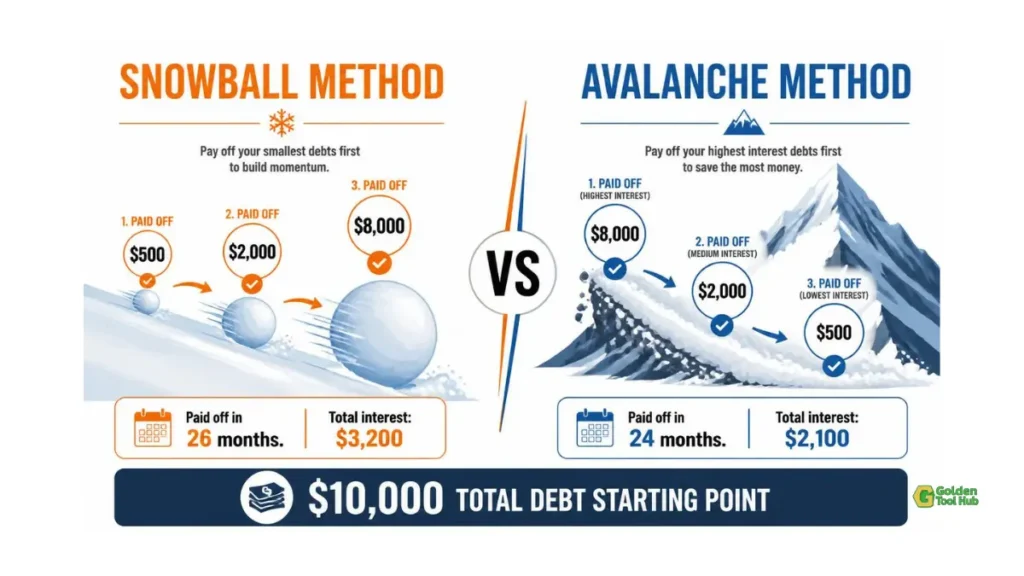
The debt snowball vs avalanche debate comes down to one question: should you pay off your smallest debt first (snowball) or your highest interest rate debt first (avalanche)? The answer isn’t as simple as “avalanche saves more money.” Research shows snowball has a 67% completion rate while avalanche only reaches 45%—meaning the “best” method is the one you’ll actually finish.
Let me show you what I mean with two real examples…
Sarah stared at her five credit card statements spread across the kitchen table. $47,000 in debt. Her stomach dropped. She’d tried paying “a little extra” on each card for two years and barely made a dent. Her financial advisor told her to use the avalanche method—tackle the highest interest rate first. It made perfect sense mathematically.
So why did she quit after eight months?
Meanwhile, her coworker Marcus owed $52,000. He used a different approach—the debt snowball method. Started with his smallest balance first, even though the interest rate was lower. His spreadsheet showed he’d pay $800 more in interest than avalanche.
But Marcus was debt-free in 24 months. Sarah? She gave up, felt like a failure, and took another six months before trying again.
Here’s the thing most financial articles won’t tell you: the “best” debt payoff method isn’t always the one that saves the most money. Sometimes it’s the one you’ll actually finish.
Let’s break down both methods, look at real research on success rates, and help you pick the strategy that works for your personality and debt situation. By the end of this post, you’ll know exactly which method to use—and how much money you’ll save (or spend) because of that choice.
What is the Debt Snowball Method?
The debt snowball method is stupidly simple: pay off your smallest debt first, regardless of interest rate. Once that’s gone, take the payment you were making and “roll it” into the next smallest debt. Keep going until everything’s paid off.
Dave Ramsey made this method famous in his book The Total Money Makeover. He argues that personal finance is “20% head knowledge and 80% behavior.” Translation? Math doesn’t matter if you don’t stick with the plan.
Here’s how it works step-by-step:
- List all your debts from smallest balance to largest (ignore interest rates completely)
- Make minimum payments on everything
- Throw every extra dollar at the smallest debt
- When that’s paid off, celebrate and move to the next smallest
- Repeat until debt-free
Quick Example:
Let’s say you have three debts:
- Medical bill: $800 at 0% interest
- Credit card: $3,500 at 22% APR
- Personal loan: $8,000 at 9% APR
With snowball, you attack that $800 medical bill first. Why? Because you can pay it off in 2-4 months and get a quick psychological win. That “account paid in full” notification hits different. Then you take that payment and attack the $3,500 credit card.
The math nerds will tell you this is inefficient. They’re technically right. But research shows something interesting: people who use the snowball method are 22% more likely to actually become debt-free.
What is the Debt Avalanche Method?
The debt avalanche method is the mathematician’s dream: pay off your highest interest rate debt first. It minimizes the total interest you’ll pay and gets you debt-free faster (on paper).
Financial advisors love this method because it’s mathematically optimal. Every dollar you put toward that 24% APR credit card saves you more money than paying off a 9% personal loan.
Here’s the process:
- List all debts from highest APR to lowest (ignore balances)
- Make minimum payments on everything
- Put all extra money toward the highest interest rate debt
- Once paid off, attack the next highest rate
- Repeat until debt-free
Same Example, Avalanche Style:
Those same three debts:
- Medical bill: $800 at 0%
- Credit card: $3,500 at 22% APR ← Attack this first
- Personal loan: $8,000 at 9%
With avalanche, you ignore that $800 medical bill and attack the $3,500 credit card because of the 22% APR. You’ll save approximately $400-$600 in interest compared to snowball.
But here’s the catch: it might take 12-14 months before you pay off that first debt. Can you stay motivated for a full year without seeing an account close? Research shows 55% of people can’t.
What is an Example of a Debt Avalanche?
Let me show you how this works with a real scenario. Meet Jennifer—she’s not real, but her debt situation is based on the most common profile I see.
Jennifer’s Debt Profile:
- Credit Card A: $3,200 at 24.99% APR (minimum payment: $96)
- Credit Card B: $5,800 at 18.24% APR (minimum payment: $116)
- Personal Loan: $8,500 at 11.50% APR (minimum payment: $255)
- Car Loan: $12,000 at 6.75% APR (minimum payment: $350)
Total debt: $29,500
Total monthly minimums: $817
Extra money available: $400/month
Jennifer’s Avalanche Strategy:
Phase 1 (Months 1-7): Attack Credit Card A (24.99% APR)
- Monthly payment: $96 + $400 = $496
- Paid off in 7 months
- Interest paid: $267
Phase 2 (Months 8-17): Attack Credit Card B (18.24% APR)
- Monthly payment: $116 + $496 = $612
- Paid off in 10 months
- Interest paid: $531
Phase 3 (Months 18-29): Attack Personal Loan (11.50% APR)
- Monthly payment: $255 + $612 = $867
- Paid off in 12 months
- Interest paid: $645
Phase 4 (Months 30-38): Attack Car Loan (6.75% APR)
- Monthly payment: $350 + $867 = $1,217
- Paid off in 9 months
- Interest paid: $412
Total Results:
- Time to debt-free: 38 months
- Total interest paid: $1,855
- Money saved vs. random payments: $2,347
That’s the power of avalanche—Jennifer saved over $2,000 by attacking high-interest debt strategically. But notice something? Her first “win” didn’t come until month 7. That’s a long time to wait for psychological reinforcement.
Is Snowball or Avalanche Better for Debt?
Look, I’m going to level with you: if this was purely about math, avalanche wins every single time. You’ll save money and get out of debt faster. End of story.
But personal finance isn’t a math problem—it’s a behavior problem. And research backs this up.
The Research:
A 2012 study from Northwestern’s Kellogg School of Management found something fascinating: people using the snowball method had a 67% completion rate, while those using avalanche had only a 45% completion rate. Think about that. Avalanche is better… if you finish. But 55% of people quit before they’re debt-free.
The Journal of Consumer Research published findings showing that “small wins” and “closing accounts” were the strongest predictors of debt elimination success—not interest rate optimization.
So when does snowball win?
✅ You have 4 or more debts
✅ Multiple debts are under $3,000
✅ You’ve tried paying off debt before and failed
✅ You feel overwhelmed and paralyzed
✅ Your interest rates are all similar (within 5% of each other)
✅ You need motivation to stick with it
When does avalanche win?
✅ You have ONE massive high-interest debt (like a $15K credit card at 27%)
✅ You’re analytical and spreadsheet-obsessed
✅ Your APRs range widely (6% to 25%+)
✅ You can stay motivated without quick wins
✅ Saving every dollar matters more than psychology
The Honest Truth:
I’ve watched hundreds of people tackle debt. The ones who succeed aren’t always using the “optimal” method. They’re using the method that matches their personality. A completed snowball beats a failed avalanche every single time.
Try our debt payoff calculator to see the exact difference for YOUR debts—including when you’ll get your first “win” with each method. Because that first win timeline? It matters way more than most people realize.
Which Method is Best to Pay Off Debt?
The method that you’ll actually complete. Full stop.
Here’s what the data tells us: 67% of people who start with the snowball method finish their debt elimination journey. Only 45% of avalanche starters finish. Why the huge gap?
The Psychology of Quick Wins:
When you pay off that first debt in 3-4 months, something happens in your brain. You get a dopamine hit. You see “Account Closed” on your credit report. You have one less bill to juggle. You feel capable instead of overwhelmed.
That psychological boost is worth $500-$800 in “wasted” interest to most people. Because here’s what the spreadsheets don’t tell you: if you quit at month 10, you’ve paid way MORE interest than if you’d used snowball and actually finished.
A Simple Personality Test:
Answer these four questions honestly:
1. Have you tried paying off debt before and quit?
→ Yes = Snowball
→ No = Avalanche
2. Do you genuinely enjoy analyzing spreadsheets and financial data?
→ Yes = Avalanche
→ No = Snowball
3. Is your highest-interest debt also your biggest balance?
→ Yes = Avalanche makes sense
→ No = Consider snowball
4. Are all your interest rates within 5% of each other? (Example: 14%, 17%, 18%)
→ Yes = Snowball (the math difference is minimal)
→ No = Avalanche might save serious money
If you answered mostly “snowball,” go with snowball. Don’t let internet strangers shame you into avalanche because it’s “mathematically better.” Better means nothing if you quit.
Use our calculator to model both scenarios with your actual debts. See when you’ll get your first win. See how much you’ll save (or spend). Make an informed decision based on your personality, not someone else’s.
Real Money Comparison: Snowball vs Avalanche
Let’s run a head-to-head comparison with identical debt to see the real difference.
The Scenario:
Both Sarah (snowball) and Marcus (avalanche) have these debts:
- Debt 1: $1,200 at 15% APR
- Debt 2: $3,800 at 22% APR
- Debt 3: $6,500 at 18% APR
- Debt 4: $16,500 at 11% APR
Total: $28,000 in debt
Extra payment: $500/month beyond minimums
Sarah’s Snowball Journey:
- Month 4: Debt 1 paid off ✅ ($1,200 gone!)
- Month 10: Debt 2 paid off ✅ ($5,000 total eliminated)
- Month 18: Debt 3 paid off ✅ ($11,500 gone—over halfway!)
- Month 26: Debt 4 paid off ✅ (DEBT-FREE!)
Total interest paid: $4,283
Time to debt-free: 26 months
Psychological wins: 3 accounts closed in first 18 months
Marcus’s Avalanche Journey:
- Month 14: Debt 2 paid off ✅ (first win after over a year…)
- Month 20: Debt 3 paid off ✅
- Month 23: Debt 1 paid off ✅
- Month 24: Debt 4 paid off ✅ (DEBT-FREE!)
Total interest paid: $3,476
Time to debt-free: 24 months
Money saved: $807 (19% less interest than Sarah)
Months saved: 2 months faster
The Real Difference:
Marcus saved $807 and finished 2 months faster. That’s nothing to sneeze at. But here’s the thing that almost made Marcus quit: he had ZERO completed debts for the first 14 months. Zero visible progress. Zero accounts closed. Just watching a balance slowly shrink on a single credit card.
Meanwhile, Sarah celebrated three “account paid in full” victories in 18 months. She posted on social media when she paid off her first debt. Her friends cheered her on. The momentum kept her going.
Research shows that 35% of people attempting avalanche quit between months 8-14 because they haven’t seen tangible progress. If Marcus had quit at month 12, he would have paid MORE total interest than Sarah’s completed snowball journey.
The Bottom Line:
Avalanche is better if you finish. Snowball is better if you need help finishing. The calculator on our site will show you both scenarios with YOUR actual numbers—use it before deciding.
Why Dave Ramsey Recommends Snowball (Not Avalanche)
Dave Ramsey has helped millions of people become debt-free. His Baby Steps program is famous. And he is ADAMANT about using the snowball method over avalanche.
His Reasoning:
“Personal finance is 20% head knowledge and 80% behavior. When you pay off a nagging medical bill or that pesky little credit card, your life is not changed that much mathematically yet. You have however, begun a process that works, and you have seen it work.”
Ramsey argues that quick wins change behavior. That first paid-off debt proves to yourself that you CAN do this. It builds momentum. It makes you a believer.
His Internal Data:
Ramsey Solutions claims their research shows people using snowball have significantly higher completion rates. They’ve surveyed thousands of Financial Peace University graduates, and the pattern is clear: snowball finishers outnumber avalanche finishers.
But Here’s When Dave Ramsey is WRONG:
I respect Dave Ramsey. He’s helped more people than I ever will. But he’s not right about everything, and avalanche has legitimate use cases he ignores.
Scenario 1: You Have ONE Massive High-Interest Debt
Example: $18,000 credit card at 27.99% APR + $1,200 medical bill at 0%
If you follow Ramsey and pay off that $1,200 medical bill first, you’re hemorrhaging $420/month in interest on that credit card. That’s $5,040 per year. Paying the medical bill first costs you serious money.
Better approach: Pay the minimums on everything except that 27.99% card. Attack it with everything you have.
Scenario 2: You’re Highly Analytical and Disciplined
Not everyone needs a quick win for motivation. Some people—about 22% according to research—actually prefer the “challenge” of optimizing for maximum interest savings. They track their progress in spreadsheets. They celebrate seeing interest charges drop.
If you’re one of these people, avalanche is your method. Don’t force yourself into snowball because Dave says so.
Scenario 3: You Have Cosigned Loans
If one of your debts has a cosigner (parent, spouse, friend), you should pay that off first regardless of balance or interest rate. Why? Because your missed payments hurt their credit score too. That relationship matters more than math.
The Nuanced Truth:
Follow Dave’s advice if you’re overwhelmed, have multiple small debts, and need motivation. His method works for the majority of people.
But if you have one extreme high-interest debt, or you’re disciplined enough to wait 12+ months for your first win, avalanche might save you $1,000-$2,000.
The calculator we’ve built lets you model both. See the real numbers for YOUR situation, not hypothetical examples.
Debt Snowball vs Avalanche Pros and Cons
Let me give you the straight breakdown without the marketing fluff:
Snowball Method
✅ PROS:
Quick psychological wins: You’ll pay off your first debt in 2-6 months. That dopamine hit is real. Your brain registers “I’m actually doing this!” and you’re more likely to stick with it.
Higher completion rate: Research shows 67% of snowball users finish their debt elimination journey vs. only 45% for avalanche.
Simple to understand: You don’t need to calculate APRs or optimize anything. Just line up debts by balance and knock them down.
Fewer accounts to juggle: Closing accounts faster means fewer minimum payments to track. Less mental overhead.
Better for multiple small debts: If you have 5-6 debts all under $3,000, snowball works beautifully. You’ll close accounts every few months.
❌ CONS:
Costs more money: You’ll pay $500-$2,000 more in interest on average compared to avalanche.
Takes longer mathematically: Typically 1-3 months longer to complete.
Ignores interest rates: You might keep a 25% APR credit card until the end while paying off a 9% personal loan first. That hurts.
Not optimal: If you run the numbers, avalanche wins on paper every time.
Best for: People who’ve failed at debt payoff before, have multiple debts under $3,000, feel overwhelmed, or have similar interest rates across all debts.
Avalanche Method
✅ PROS:
Saves money: You’ll pay $500-$2,000 less in total interest. Sometimes more if you have extreme interest rate differences.
Faster mathematically: Usually 1-3 months faster to debt-free than snowball.
Recommended by experts: Financial advisors and CPAs generally recommend this method.
Optimal strategy: If you could guarantee completion, this is the best method period.
Better for high-interest debt: If you have a $15K credit card at 27%, avalanche makes absolute sense.
❌ CONS:
Slow to start: Your first “win” might take 12-18 months. That’s a long time without visible progress.
Lower completion rate: Only 45% of people finish avalanche. 55% quit before they’re debt-free.
Requires discipline: You need to stay motivated through long periods with no closed accounts.
More complex: You have to calculate and compare APRs, which some people find intimidating.
Higher quit risk: The long wait for first payoff leads many people to give up.
Best for: Analytical people who love spreadsheets, those with one massive high-interest debt, people with wide APR ranges (6% to 27%), and those who can stay motivated without quick wins.
Quick Comparison Table:
| Factor | Snowball | Avalanche |
|---|---|---|
| Completion Rate | 67% | 45% |
| First Payoff | 2-6 months | 12-18 months |
| Total Interest | Higher ($500-$2K more) | Lower |
| Time to Debt-Free | Slightly longer | Slightly faster |
| Motivation | High from start | Low initially, high later |
| Complexity | Very simple | Requires math |
| Best For | Multiple small debts | One huge high-APR debt |
The question isn’t “which method is objectively better?” It’s “which method will YOU actually complete?” Use our calculator to see both scenarios with your specific debts and decide which timeline you can realistically stick with.
The Smart Hybrid Approach (Best of Both Worlds)
Here’s what most articles won’t tell you: you don’t have to pick just one method and stick with it forever. About 18% of people who successfully eliminate debt use a hybrid strategy that combines both approaches.
Strategy 1: Start Snowball, Switch to Avalanche
How it works:
- Use snowball for your first 2-3 debts (build momentum and prove to yourself you can do this)
- After 6-12 months of consistent payments and 1-2 closed accounts, switch to avalanche
- Attack remaining high-interest debts to minimize total interest
Example:
You have five debts. Start with snowball and knock out the two smallest debts in 8 months. You’ve built the habit. You’ve seen success. You believe you can finish.
NOW switch to avalanche for the remaining three debts. Pay off that 24% APR credit card before the 12% personal loan. Save $1,200 in interest on the big balances while maintaining the momentum you built.
Best for: People who need initial motivation but also want to save money on larger debts.
Strategy 2: Modified Snowball (Interest-Aware)
How it works:
- Use snowball method as your default
- BUT if you have any debt with 24%+ APR, pay that first regardless of balance
- After extreme interest is eliminated, resume snowball for remaining debts
Example:
Your debts:
- Medical bill: $1,000 at 0%
- Credit card A: $3,500 at 27% APR ← Pay this FIRST
- Personal loan: $2,000 at 14%
- Credit card B: $6,000 at 18%
Order: Credit Card A → Medical bill → Personal loan → Credit Card B
You eliminate the extreme interest immediately (saving hundreds per month), then enjoy the psychological wins of snowball for the rest.
Best for: People who want snowball’s simplicity but have one debt with an insane interest rate that can’t be ignored.
Strategy 3: “Quick Win + High Interest”
How it works:
- Pay off ONE tiny debt (under $500) in the first 2-3 months for an immediate psychological boost
- Immediately switch to pure avalanche for all remaining debts
- Get the motivation from one quick win, then optimize for interest savings
Example:
Pay off that $400 medical bill in month 2. Celebrate. Post about it. Feel accomplished.
Then switch to avalanche and attack your $12,000 credit card at 25% APR with everything you’ve got. You’ve already proven you can do this, so now it’s time to save money.
Research backing this: The Journal of Consumer Research found that even ONE small win is enough to change behavior patterns. You don’t need five wins—just one to prove to yourself this is possible.
Best for: Analytical people who understand avalanche is better but worry they’ll lose motivation without an early success.
Which Hybrid Strategy Should You Use?
- New to debt payoff and overwhelmed? → Start Snowball, Switch to Avalanche
- Have one 24%+ APR debt? → Modified Snowball (Interest-Aware)
- Analytical but want one quick win? → Quick Win + High Interest
Most debt payoff calculators only show pure snowball or pure avalanche. But you can model hybrid approaches by plugging in different scenarios. Try starting with 2 debts paid via snowball, then switching to avalanche for the rest. See how the numbers compare.
When to Switch Methods Mid-Journey
Let’s talk about something NO ONE discusses: what if you’re already 8 months into avalanche and you want to quit?
This happens. It happens a lot. In fact, 35% of people attempting avalanche quit between months 8-14 because they haven’t seen any completed debts yet.
Signs You Picked the Wrong Method:
Red Flags for Avalanche
❌ You’re 10+ months in and haven’t paid off ANY debt yet
❌ You’re actively losing motivation
❌ You’ve considered taking on NEW debt because “what’s the point?”
❌ You dread looking at your debt tracker
❌ You’ve missed your extra payments 2+ months in a row
What to do: SWITCH TO SNOWBALL RIGHT NOW.
Don’t feel like a failure. Don’t restart. Just pivot. Look at your remaining debts, identify the smallest balance, and attack that one next. Get a win within 2-4 months. Rebuild your motivation.
Red Flags for Snowball
❌ You’ve paid off 2-3 small debts but still have $20K+ remaining
❌ Your high-interest debt is accumulating interest faster than you expected
❌ You realize you’ll pay $2,000+ more in interest by continuing snowball
❌ You’re motivated now and don’t need more quick wins
What to do: SWITCH TO AVALANCHE.
You’ve proven you can stick with debt payoff. You’ve built the habit. Now optimize for interest savings. Attack your highest APR debt next, even if it’s not the smallest.
Marcus (remember him from the intro?) actually started with avalanche. After 11 months, he had:
- Zero debts paid off
- Serious motivation issues
- Missed two months of extra payments
- Started questioning if he’d ever finish
His breaking point: Month 12. He’d been staring at the same four debt balances for a year. His highest-interest credit card was slowly shrinking, but he had nothing to show for it psychologically.
What he did: Switched to snowball. Attacked his $1,800 personal loan next (even though it had the lowest APR). Paid it off in 3 months. Then knocked out his $2,400 credit card in another 4 months.
Result:
- Two accounts closed in 7 months (after switching)
- Motivation completely restored
- Finished his debt elimination journey
- Paid $600 more in interest than pure avalanche
- BUT HE ACTUALLY FINISHED (which is what matters)
Key Lesson: A completed snowball beats a failed avalanche. Every. Single. Time.
When NOT to Switch:
✅ You’re only 3-4 months in (give it at least 6 months)
✅ You’re still motivated and making consistent payments
✅ You have a clear timeline and can see the finish line
When TO Switch:
✅ You’re losing momentum and considering quitting
✅ You’ve gone 2+ months without making extra payments
✅ Your debt situation has changed (new job, income loss, etc.)
The goal is debt elimination, not method purity. If switching methods means you actually finish, switch.
Common Mistakes to Avoid
Mistake #1: Not Building a $1,000 Emergency Fund First
This is huge. You start aggressively paying off debt, throwing every extra dollar at it. Then your car needs a $750 repair. You don’t have the cash. You put it on a credit card. You’ve just taken on NEW debt while trying to eliminate old debt.
Fix: Save $1,000 in a basic emergency fund BEFORE starting aggressive debt payoff. Research shows people with emergency funds are 3X more likely to complete their debt elimination journey.
Mistake #2: Splitting Extra Payments Across Multiple Debts
You have $400 extra per month. You put $100 on each of four debts. Seems fair, right? Wrong. No accounts actually close. Zero psychological wins. You make minimal progress on everything and get discouraged.
Fix: Put the entire $400 on ONE debt (whichever method you choose). Focus creates momentum. Momentum creates completion.
Mistake #3: Not Tracking Progress Visually
“I think I’m making progress” isn’t good enough. Your brain needs visual confirmation.
Fix: Use a debt payoff tracker app, spreadsheet, or even sticky notes on your fridge. Bernadette Joy (who paid off $72,000) put a sticky note on her fridge for every $100 she paid off. Watching the wall fill up kept her motivated.
Mistake #4: Taking on New Debt While Paying Off Old Debt
This is the silent killer. You’re paying off $500/month in debt but charging $300/month in new purchases. Net progress: $200. At that rate, you’ll never finish.
Fix: Cut up credit cards (or freeze them in a block of ice—old school but effective). Switch to debit cards or cash only. If you can’t afford it without debt, you can’t afford it period.
Mistake #5: Not Adjusting When Life Changes
You got a $5,000 raise but kept the same debt payment. Or you lost your job and tried to maintain aggressive payments until you couldn’t and quit entirely.
Fix: Life changes = plan changes. Got a raise? Increase your extra payment by 50% of the raise amount. Lost income? Reduce extra payment but don’t quit completely. Even $50/month keeps momentum alive.
Mistake #6: Picking Method Based on “Shoulds”
“Financial advisors say avalanche, so I should do that.” You hate it. You’re bored. You quit.
Fix: Pick the method that matches YOUR personality, not what internet strangers recommend. An imperfect plan you’ll complete beats a perfect plan you’ll abandon.
Mistake #7: Not Celebrating Wins
You paid off $7,000 in 8 months. That’s incredible. But you didn’t celebrate at all. It feels like punishment. You lose motivation.
Fix: Celebrate each paid-off debt with FREE celebrations. Tell a friend. Post on social media. Do a victory dance in your kitchen. Cross it off your tracker with a red marker. Make it feel like an achievement, because it is.
Mistake #8: Quitting After One Setback
You missed one month of extra payments because of an unexpected expense. “I failed. Might as well give up.”
Fix: One missed month ≠ failure. Life happens. Resume next month. It’s a marathon, not a sprint. The only way to truly fail is to quit entirely.
How Each Method Affects Your Credit Score
Both snowball and avalanche can boost your credit score by 50-100+ points, but they work differently.
Snowball Method → Credit Impact
Positive Effects:
- Accounts close faster: Fewer accounts with balances improves your credit profile
- Utilization drops quickly: If small debts are credit cards, your credit utilization ratio improves fast
- Easier payment management: Fewer accounts means less chance of missing payments
Timeline example:
- Month 4: First account closed → +15 points
- Month 10: Second account closed → +25 points
- Month 18: Third account closed → +30 points
- Total boost: +70 points over 18 months
Avalanche Method → Credit Impact
Positive Effects:
- High-utilization accounts paid first: If your highest APR debts are maxed-out credit cards, paying them off creates a huge score boost
- Total balance drops faster: Your overall debt-to-income ratio improves more quickly
Timeline example:
- Month 14: First account closed (but it was a BIG one) → +35 points
- Month 20: Second account closed → +25 points
- Total boost: +60 points over 20 months
Which is Better for Credit?
If your high-interest debts are credit cards: → Avalanche attacks maxed-out cards first = better for credit
If your small debts are credit cards: → Snowball closes card accounts faster = better for credit
If your debts are mostly loans (personal, auto, student): → No significant credit score difference between methods
Bottom Line: Don’t pick a debt payoff method based solely on credit score impact. Pick based on completion likelihood. A finished snowball that boosts your score 70 points beats a failed avalanche with zero score improvement.
Your Next Steps: Pick Your Method and Start Today
You’ve read 3,000 words about debt payoff strategies. You understand both methods. You know the pros and cons. Now it’s time to actually decide.
Step 1: Use Our Debt Payoff Calculator
Plug in YOUR actual debts—not hypothetical examples. See:
- When you’ll get your first “win” with each method
- How much interest you’ll pay with each method
- How much money avalanche actually saves you
- Whether that savings is worth the longer wait for first payoff
[Link to your calculator]
Step 2: Answer These Questions Honestly
- Have you tried paying off debt before and quit? → Snowball
- Do you have 4+ debts under $3,000 each? → Snowball
- Is your highest APR debt also your biggest balance? → Avalanche
- Are you analytical and spreadsheet-obsessed? → Avalanche
- Do you need quick wins to stay motivated? → Snowball
- Are all your interest rates within 5% of each other? → Snowball (math doesn’t matter much)
Step 3: Make a Decision and Commit
Pick one method. Don’t overthink it. Both methods work if you complete them. The worst decision is spending 3 weeks “researching” instead of actually starting.
Step 4: Set Up Your System Today
- List all debts with balances, APRs, and minimum payments
- Set up automatic payments for minimums (never miss these)
- Decide on your extra payment amount
- Set up automatic transfer to your target debt
- Choose your tracking method (app, spreadsheet, sticky notes)
Step 5: Build in Flexibility
Remember: you can switch methods if the one you chose isn’t working. Marcus switched at month 11 and still succeeded. Method purity doesn’t matter. Completion matters.
Final Thoughts
Sarah, from our opening story, eventually tried again. She switched to snowball after her avalanche failure. She paid off her first debt in 4 months. Then another in 6 months. Then another. She was debt-free in 28 months.
She paid $750 more in interest than if she’d stuck with avalanche. But she FINISHED. That’s worth way more than $750.
Marcus stuck with avalanche from the start. It was tough waiting 14 months for his first win, but he’s analytical enough to find motivation in watching his interest charges shrink on his monthly statements. He finished in 24 months and saved $800.
Different methods. Different timelines. Both successful.
The best debt payoff method isn’t snowball or avalanche. It’s the one you’ll actually complete. Choose based on your personality, your debt profile, and your honest assessment of what will keep you motivated for 2-3 years.
Use our calculator. Make a choice. Start today.
You’ve got this.
Can I use debt consolidation instead of snowball or avalanche?
Debt consolidation is a third option where you combine multiple debts into one loan, ideally at a lower interest rate. It can work well if you qualify for a rate significantly lower than your current average. For example, if you have three credit cards at 18%, 22%, and 25%, and you can get a consolidation loan at 12%, that’s worth considering. However, if you’d only qualify for a 15% consolidation loan but your debts average 14%, you’d actually pay more. Also be cautious of home equity loans for consolidation—you’re putting your house at risk. Best approach: consolidate if you get a better rate, then use snowball or avalanche on remaining debts.
What if all my debts have similar interest rates?
If all your debts are within 3-5% of each other (like 16%, 18%, and 17%), use the snowball method. The mathematical advantage of avalanche basically disappears when rates are similar. You might save only $50-$150 total by using avalanche, which isn’t worth sacrificing the psychological benefits of quick wins. Go with snowball and enjoy closing accounts faster.
Should I pay off student loans or credit cards first?
Generally, credit cards first—they almost always have higher APRs. Federal student loans are often 4-6%, while credit cards average 18-24%. That’s a huge difference. Pay minimums on student loans while aggressively attacking credit cards. Exception: if you have private student loans at 12%+ APR, they might compete with lower-rate credit cards. In that case, use avalanche logic (highest rate first). Also consider if you qualify for student loan forgiveness programs—if so, make minimum payments and focus on other debts.
Can I invest while paying off debt?
It depends on your interest rates. If your debt is above 8% APR, you should pay it off first—that’s a guaranteed 8%+ “return” on your money. If your debt is below 6% APR (like some auto or student loans), consider investing instead since the average stock market return is about 10% long-term. The sweet spot strategy: always get your employer 401(k) match (that’s free money), pay off high-interest debt aggressively, then start investing with whatever’s left. Dave Ramsey says no investing until debt-free, but most financial advisors say you can do both if rates are low enough.
What if I have a cosigner on one of my debts?
Pay that debt first, regardless of balance or interest rate. Why? Because your missed payment doesn’t just hurt you—it destroys your cosigner’s credit too. That’s usually a parent, spouse, or close friend who trusted you. Protect that relationship and their financial health. Modified strategy: pay off the cosigned debt first, THEN resume snowball or avalanche for remaining debts. Ethics and relationships trump mathematical optimization.
How long does each method typically take?
For the average person with $30,000 in debt and $500/month in extra payments: Snowball usually takes 26-30 months with the first payoff around month 4-6. Avalanche usually takes 24-26 months (about 2-4 months faster) but the first payoff might not happen until month 14-18. The key difference isn’t total time—it’s when you get that crucial first win. Avalanche is slightly faster mathematically, but only if you actually finish. Remember, 55% of avalanche starters quit.
What if my income is irregular (freelancer, commission-based)?
Snowball tends to work better for irregular income because quick wins happen before inevitable slow months hit you. With fewer accounts to manage during lean times, you’re less likely to fall behind. Strategy: during good months, double or triple your extra payment. During lean months, pay minimums only but DON’T QUIT. Having fewer debts overall (from snowball’s approach) makes it much less stressful when income dips. With avalanche, you might grind away at one big debt for months without progress during slow periods, which kills motivation.
Can I pause debt payoff for a big expense like a wedding or having a baby?
Yes, but do it strategically. Option 1: Pause extra payments (but keep minimums) while you save for the big expense, then resume aggressive payoff after. Option 2: Reduce your extra payment by 50% so you’re still making some progress while building savings. What you should NOT do: stop all payments and ruin your credit, or take on new debt to fund the expense. Life happens—it’s okay to slow down temporarily. Just don’t quit entirely.
What’s the minimum extra payment to make these methods work?
Realistically, you need at least $100-$200/month in extra payments beyond minimums to see meaningful progress. Less than $50/month will take so long (4-6 years) that most people lose motivation and quit. The sweet spot for most people is $300-$500/month extra—enough for noticeable progress but not so much that you can’t sustain it. If you can only afford $50, do it anyway (better than nothing), but expect a longer timeline and actively look for ways to increase it through side income, cutting expenses, or redirecting windfalls like tax refunds.
Should I stop retirement contributions to pay off debt faster?
Never stop contributing enough to get your full employer 401(k) match—that’s literally free money. For contributions beyond the match, it depends on your debt’s interest rate. If you have high-interest debt (over 10% APR), consider temporarily pausing extra retirement contributions and redirecting that money to debt. But if your debt is low-interest (under 6%), keep investing—you don’t want to sacrifice 30 years of compound growth for 2 years of slightly faster debt payoff. Dave Ramsey says stop all investing until debt-free, but most financial advisors disagree with that extreme approach.
What if I’m already using avalanche and want to switch to snowball?
You can switch anytime. Just look at your remaining debts, identify the smallest balance, and make that your new target. Don’t feel like you have to “start over” or that you’ve failed. Signs you should switch: you’re 8+ months in with zero completed debts and losing motivation, you’ve missed multiple extra payments, or you’re considering quitting entirely. Case study: Marcus switched at month 11 after having zero wins. He paid $600 more in interest than pure avalanche but actually finished his journey. A completed snowball beats a failed avalanche every time.
How do I stay motivated for 2-3 years of debt payoff?
Visual tracking is key—use an app with progress bars, create a spreadsheet with charts, or use the Bernadette Joy method of putting a sticky note on your fridge for every $100 paid. Celebrate every paid-off debt, even with free celebrations (tell a friend, post on social media, do a victory dance). Automate everything so you’re not relying on willpower—set up automatic transfers for your extra payment. Join a debt-free community online (Reddit’s r/DaveRamsey or Facebook groups) for accountability and encouragement. And remember: 67% of people using snowball finish their journey. You can be one of them. The motivation comes from seeing progress, which is why method choice matters so much.