
Paint Cost Estimator (Gallons & Project Budget)
Paint Cost Estimator
Calculate gallons needed & project budget
Planning a room refresh or a full house repaint is a big move. Let’s be honest here. The math can be a total headache. You want to know the actual paint requirements without buying four extra gallons that just sit in your garage. This paint cost estimator gives you the precise numbers you need. In 2026, quality interior paint usually costs between $35 and $75 per gallon. If you’re planning a standard room project, your budget will likely land between $150 and $400 for materials. It really just depends on your specific wall size and the brand you choose.
How to use this paint calculator
- Measure your wall width. Get the total length of all walls you want to paint in feet.
- Measure wall height. Standard ceilings are usually 8 or 9 feet high.
- Choose your coats. I always recommend two coats for a professional finish.
- Enter the price. Check the price per gallon of your preferred brand at the store.
The Paint Coverage Formula
This paint cost estimator uses the industry standard math to give you a safe estimate.
((Total Width x Wall Height) x Number of Coats) / 350 = Total Gallons.
What Affects Paint Coverage?
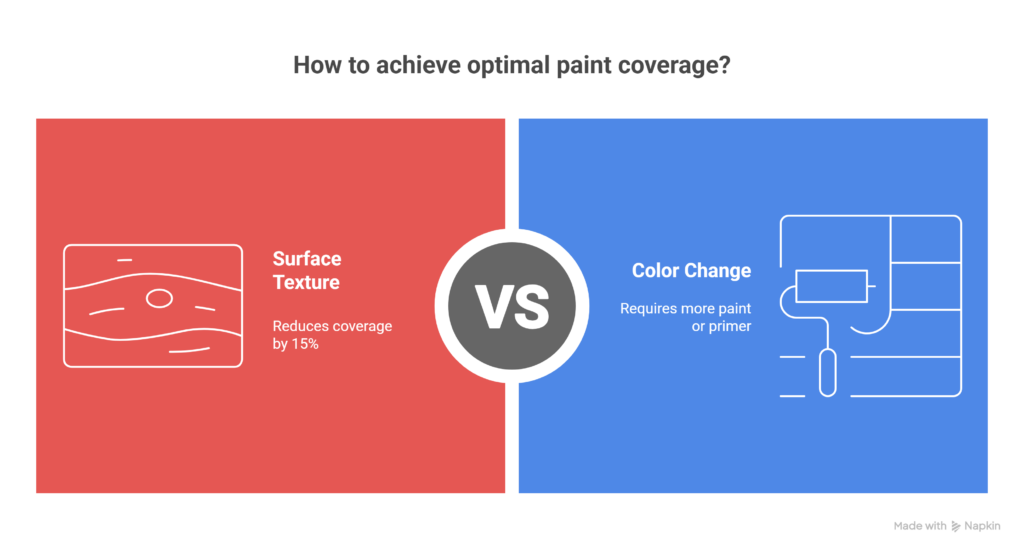
You might think every gallon behaves the same. It doesn’t. Several things change your final coverage. The biggest factor is the surface texture. If you have “popcorn” or “knockdown” textures, your walls have more surface area than flat drywall. This can reduce your coverage by 15 percent.
This paint cost estimator uses the industry standard math to give you a safe estimate.
((Total Width x Wall Height) x Number of Coats) / 350 = Total Gallons.
Standard interior paint covers between 300 and 400 square feet per gallon. We use 350 in our math because it accounts for the drywall soaking up the liquid and minor spills. We always round up to the nearest whole gallon. It’s much better to have a quart left over for future touch ups than to be a quart short while finishing the last wall of your master bedroom. Nobody wants to stop a project halfway through for a hardware store run.
Another factor is the color change. If you are painting a light “off-white” over a dark “navy blue” wall, you will need more paint. Even the best “one-coat” paints often struggle with high-contrast color shifts. In these cases, using a dedicated primer first is actually cheaper than using three coats of expensive premium paint.
Pro Tips for Accurate Budgeting
Don’t subtract doors and windows from your width calculation. Most standard rooms have one door and two windows. Leaving these in the math provides a “safety buffer” of about half a gallon. You’ll use this for the inevitable touch ups later.
Also, remember the ceiling. Most people forget to budget for ceiling paint. Ceilings are often highly porous and might need more paint than the walls. If you are painting the ceiling the same color as the walls, just add the floor square footage to your total wall area before calculating.


