
Wall Stud Calculator (Lumber & Framing Estimator)
Wall Stud Calculator
Calculate studs and plates for framing
Planning a basement finish or a new backyard shed is a satisfying project. But let’s be honest. Standing in the lumber aisle trying to count 2x4s on your fingers is a recipe for a second trip to the store. This wall stud calculator gives you the exact lumber count you need based on your wall length. In 2026, a standard 8-foot 2×4 stud usually costs between $4 and $9. Using this tool ensures you buy exactly what you need for a sturdy frame without overspending on excess wood that will just rot in your yard. It is all about professional results without the retail stress.
Don’t lose your lumber list: Press Ctrl+D (or Cmd+D) to bookmark this wall stud calculator. Keep it ready for your next framing or shed project.
Functional Explanation: How it Works
Our wall stud calculator uses a standard engineering formula to ensure your frame is structurally sound. You provide the total length of the wall and choose your spacing. Most residential homes use 16-inch spacing, while utility sheds often use 24-inch spacing. The tool determines how many vertical studs are required and adds the horizontal plates for the top and bottom of the wall. This ensures your drywall edges always land on a solid wood edge for a flat finish.
Use-Cases: Who is This Tool For?
- DIY Builders: Perfect for homeowners finishing a laundry room or building a home office partition.
- Shed Builders: Use this to calculate the raw skeleton of outdoor storage buildings or workshops.
- Lumber Yard Pros: Quickly verify a customer’s order before the truck leaves the loading dock.
- Students: A great resource for learning the fundamental components of residential wood-frame construction.
Benefits vs. Features
This wall stud calculator offers specific features that lead to better project outcomes. Our spacing selector allows for custom framing needs beyond the standard residential rules. A major benefit of this tool is the reduction of material waste. By knowing your exact count, you save money on delivery fees and avoid having a pile of warped lumber left over. Precision in the planning stage means a faster build on the job site.
Common Problems This Tool Solves
- Material Shortages: Stops the “one-stud short” nightmare that halts your project on a Sunday afternoon.
- Plate Confusion: Many people forget the horizontal boards at the top and bottom. Our tool includes them automatically.
- Spacing Errors: Ensures you follow local building codes by keeping your vertical supports at the correct distance.
- Budget Overruns: Helps you get an accurate quote for lumber before you swipe your card at the store.
The Wall Framing Formula
Our wall stud calculator follows a proven mathematical rule. We take the wall length in inches and divide it by the spacing in inches. We then add one stud to account for the end of the wall.
The base formula is: (Wall Length / Spacing) + 1.
For the plates, we multiply the wall length by three. This accounts for one bottom plate and a double top plate. A double top plate is the safety standard for load-bearing walls in 2026. This math keeps your structure stiff and prevents your drywall from cracking over time.
Why 16 Inches On-Center is the Standard
You might wonder why we don’t just space studs every two feet to save money. The 16 inch spacing is designed to match the strength requirements of drywall and siding.
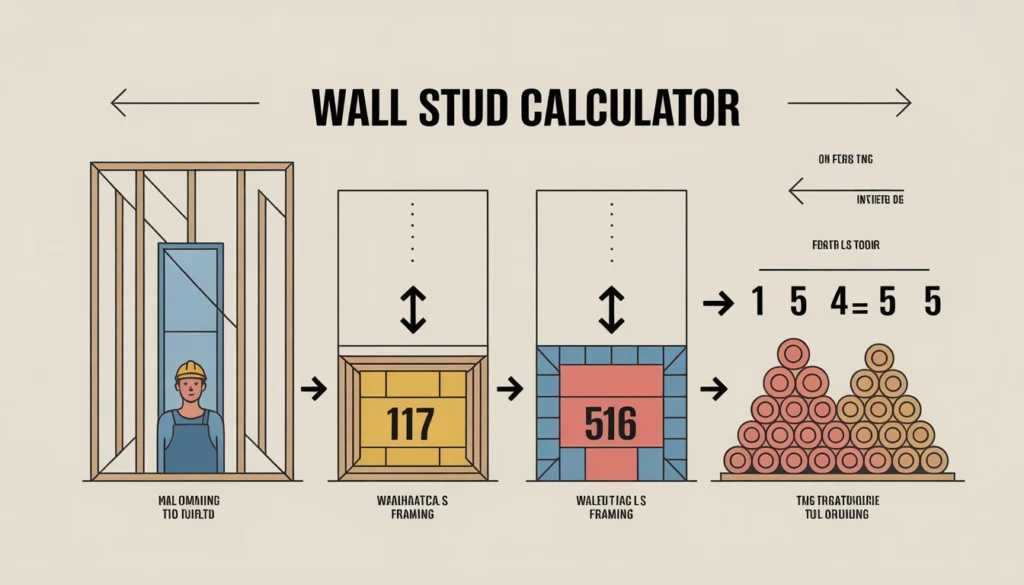
Most building materials come in 4 foot or 8 foot widths. Because 16 inches goes into 48 inches exactly three times, your drywall edges will always land perfectly in the middle of a wood stud. This simple rule prevents sagging. It also ensures your walls stay flat for decades. Our wall stud calculator uses this 16 inch standard to give you a structurally sound material count every time.
Manual Counting vs. This Tool
You could count every vertical board by hand, but it takes time and leads to human error. Even a small mistake in your math can leave your wall weak. This wall stud calculator is more reliable than a quick guess written on a scrap of cardboard. It gives you technical confidence so you can focus on the actual construction work instead of the arithmetic.
Trust and Safety Signals
- Zero Data Tracking: We don’t save or sell your room dimensions.
- Browser-Side Processing: The tool runs on your device, making it fast and private.
- No Signups: You don’t need an account to get a professional estimate.
- Fast Loading: Built for quick use on a construction site with a weak signal.
📏 Measure First: Need the exact area before you buy lumber? Use our Square Footage Calculator to get your wall dimensions right.


